TheRelevance TrapBack to homepage
An executive adjusting his tie while studying his reflection in an arched mirror.

A moment of recognition

The Diagnostic Mirror

Sometimes the clearest view of your career comes from a more honest mirror.

Career stagnation rarely announces itself clearly. You may still be doing good work, receiving strong reviews and carrying significant responsibility — yet something about your progress, influence or opportunities begins to feel different.

The signs can appear unrelated when you experience them one at a time. Seen together, however, they may reveal a pattern in how your professional relevance is changing.

Recognise the signs.
See the pattern.
Then decide what you want to understand next.

  1. Doing well, but not moving forward

    You are doing good work. Your reviews are strong. But your career does not seem to be moving. New opportunities may be appearing less often, even though the quality of your work has not declined.

    Effort continues. Progress does not.

  2. Working harder, but getting no further

    You take on more, solve more problems and become someone everyone depends on. But all that responsibility does not seem to create more influence, visibility or opportunity.

    More work. The same position.

  3. Doing the work, but not part of the conversation

    You are trusted to get things done. But important conversations and decisions increasingly happen without you. You may hear about the direction after it has already been decided.

    Trusted to deliver. Less often invited to shape.

  4. Nothing is wrong. But something doesn't feel right.

    You are valued. You are busy. Your job may even feel secure. But somehow your career seems to be getting smaller rather than bigger, and it can be difficult to explain exactly why.

    Secure, perhaps. But still moving forward?

Institutional Physics

Careers do not move on competence alone. They move according to structural forces inside organisations.

Execution Space vs Interpretive Space

Execution space proves you can be trusted to carry weight once the path has been set; interpretive space operates earlier to shape the path itself.

An open-plan executive floor: rows of desks on one side, an open interpretive gallery on the other.

Introduced here. Developed fully in the book.

Reconstruction

Relevance is not reconstructed through a single intervention. It requires structural, behavioural and psychological change.

STRUCTURAL

Change where your judgement enters the organisation.

Get involved earlier, before important decisions have already been made. Spend less time only solving problems and more time helping decide what should be done and why.

Execution → Interpretation · Thinking Space · Earned Entry · Relevance Audit · Breaking the Vertical Filter

BEHAVIOURAL

Change how you contribute when the organisation reaches for the old version of you.

Don’t automatically become the person who fixes every problem. Step back from some of the day-to-day solving and use your experience to spot patterns, improve how things work and help others make better decisions.

First Refusal · Selective Problem Solving · Pattern over Detail · Interpretive Standing

PSYCHOLOGICAL

Change the authority the organisation holds over how you see yourself.

Don’t let your current role or organisation become the only measure of what you are capable of. Keep learning, stay connected to the world outside, and understand what other opportunities may be open to you.

Psychological Break · Retraining · External Proof of Life · Market Readiness · Rational Exit · Strategic Separation

A continuous architectural panorama moving from an enclosed concrete portal, through a deep interpretive interior, to full-height glass opening onto a distant horizon.

Reconstruction begins when you stop trying to solve a structural problem with more effort.

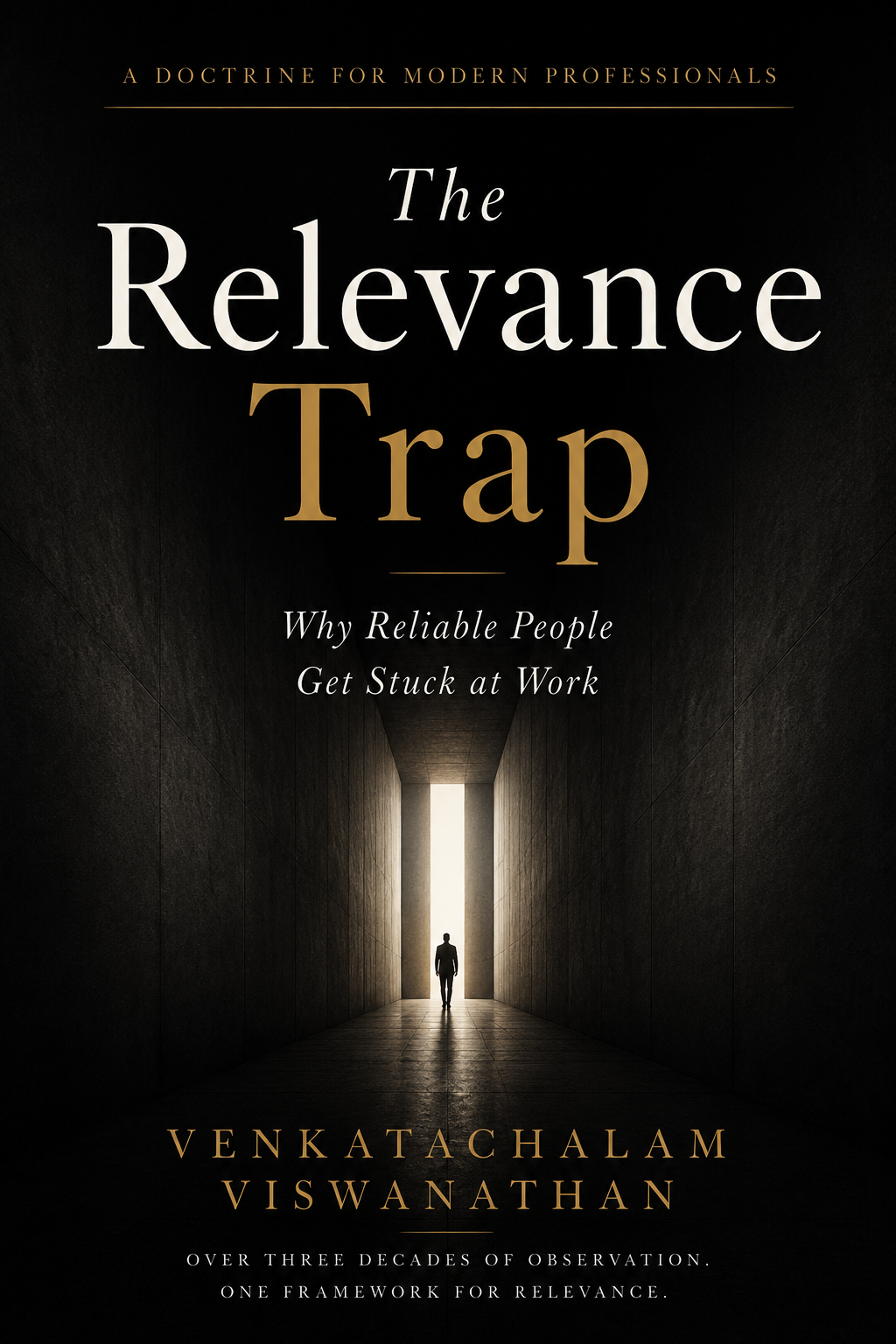
The Relevance Trap book cover
The complete articulation of The Relevance Trap doctrine.

Why This Doctrine Exists

The Relevance Trap exists because a remarkably common experience remains structurally misunderstood: highly competent, hardworking professionals lose career momentum despite continuing to do almost everything right. With little explanation for why progress has stalled, they are left with a quiet, unspoken frustration — and often begin to look for the failure in themselves.

Developed from over three decades of observing how careers rise, plateau and quietly disappear, the doctrine examines the hidden organisational forces behind that drift: how reliability can narrow the way value is understood, how capable professionals become indispensable stabilisers of the present, and how relevance can be reconstructed by moving from execution space into interpretive space.


“There is a difference between being trapped and choosing to stay.

The purpose of The Relevance Trap is not to suggest that everyone must continue climbing throughout their professional life. Nor is relevance an end in itself.

Perhaps the real objective is not to maximise professional relevance. It is to retain the ability to choose what deserves your relevance.

And when that choice is conscious, perhaps there is no trap at all.”

— from the Epilogue of The Relevance Trap

Explore The Relevance Trap

Go deeper into the ideas, understand where you stand, or continue exploring The Relevance Trap.

THE BOOK

The Relevance Trap

Understand why capable, experienced professionals can keep doing well — and still find their careers slowing down.

The Relevance Trap: Why Reliable People Get Stuck at Work by Venkatachalam Viswanathan
A quiet architectural stairway suggesting the next stage of a professional journey

THE DIAGNOSTIC

Professional Relevance Diagnostic

Understand where you stand, what may be holding you back, and what you can do to keep moving forward.

Take the Diagnostic