The Professional Relevance Coach
The proverbial tip of the iceberg
Venkatachalam Viswanathan · Founder, The Relevance Trap | Author of The Relevance Trap · 17 October 2026
Here I was, at a BNI chapter meeting, early in the morning, when someone casually asked me a question. “And what do you do?” I paused. After three decades, I paused over an identity. Finally, I said, “I am a Relevance Coach.”
“Ah, okay! A business coach. Wonderful!”
I had barely uttered my new identity when someone had conveniently slotted me into a familiar one. I reiterated, “No, I am a Professional Relevance Coach.”
It was a brief exchange, but it stayed with me. It highlighted something I had been thinking about: how little coaching as a professional service is understood, and even more importantly, what exactly does a professional coach do?
When competence is no longer enough
For decades, I worked in a corporate environment, a crucible where professionals of all hues came to work, build careers, make a living and, in the process, build identities they could be proud of.
But I also observed something that was difficult to explain.
Highly competent professionals, extremely capable and efficient, would suddenly find themselves losing momentum. Their performance remained strong, their contributions were recognised, and yet they were no longer being considered for growth or for the future. My question was simple. Why does this happen? What changed?
My response to this phenomenon, one that I had seen consistently across corporate environments but felt was least understood, was my book, The Relevance Trap. The book explored a question that had increasingly occupied my thinking: why do competent professionals lose their relevance, why does it happen, and what can be done about it? But writing the book led me to another question. If identifying this phenomenon was so difficult that I had called it a trap, how could we measure it?
From understanding relevance to measuring it
That was when The Relevance Trap Diagnostic was born.
I wanted to develop a deliberate and detailed way for professionals to assess their relevance, rather than rely entirely on their own perceptions or the feedback they received at work. The diagnostic begins with a series of questions developed from 32 criteria. It then follows with an adaptive assessment of areas where the initial responses do not establish sufficient clarity. The design examines the direction and consistency of responses against each criterion. Where responses are contradictory or insufficiently clear, further questions seek clarification.
But something interesting emerged.
The reports were returning several criteria for which a confident assessment could not be established. Even after the adaptive questioning, some areas remained unresolved. This was not necessarily a failure of the diagnostic. It was also a consequence of being deliberate about what could, and could not, be concluded from the available responses. Some uncertainties arose because evidence was insufficient. Others reflected contradictory responses. And in some cases, the professional may not yet have developed a clear understanding of their own circumstances. These were not all the same problem, and they could not necessarily be resolved by simply asking more questions through a structured assessment.
That led me to another question. If the diagnostic could not establish clarity in certain areas, what would help a professional understand what was really happening? I began to see that some uncertainties needed a different kind of exploration. Not necessarily another assessment, but a conversation in which the professional could reflect on their experiences, assumptions and choices.
And that was where I began to see a role for coaching.
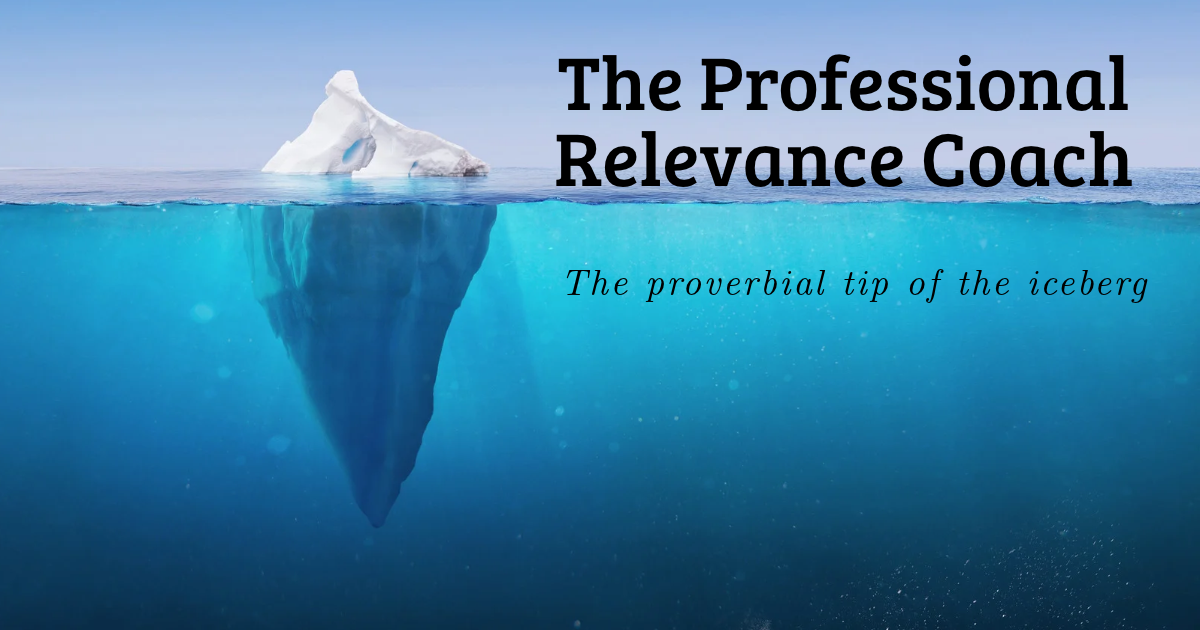
What lies beneath the surface?
When I first developed the concept of professional relevance, I realised that its reconstruction would need to address three layers: the structural, the behavioural and the psychological.
Structural factors may concern the role itself, its scope, the opportunities available and the environment in which the professional works. Behavioural factors concern how the professional operates, engages with others and responds to changing expectations. Psychological factors involve the beliefs, perceptions and assumptions that influence these behaviours.
But the deeper question is what lies beneath the visible manifestations of all three. What do professionals believe about their own capabilities? What assumptions have they made about their careers? What are they holding on to, and what are they afraid of losing? These are not necessarily questions that a diagnostic can answer. They require reflection and further exploration. Sometimes, they also require the courage to question beliefs that have shaped an entire professional life.
And that is where a coaching conversation could make the greatest impact.
The stickiness of why
Consider a professional who has spent years building a reputation for competence and reliability. The organisation depends on this person. They are praised and recognised, and their performance remains consistently strong.
Yet, when opportunities for advancement arise, they are overlooked.
The diagnostic may reveal structural limitations, such as a role that offers little scope for growth. It may identify behavioural patterns, such as an inability to delegate or a reluctance to seek visibility.
But what lies beneath these?
During my coaching education with Erickson Coaching International, I came across an expression used by Gaurav Arora, a Master Certified Coach (MCC) and a leader in the Erickson coaching community in India. He described something that stayed with me: “The stickiness of why.” It captures how deeply our assumptions and beliefs can become embedded in the way we think and act, sometimes without our even realising it.
Does the professional believe that being indispensable is the same as being relevant? Are they reluctant to delegate because they fear losing their importance? Have they come to believe that good work alone should speak for itself? These are possibilities to explore, not conclusions to impose without further assessment.
A coaching conversation may help the professional examine such assumptions, discover perspectives they had not considered and decide what they want to do differently. And the conversation need not stop there. It may extend to how they approach their role, their relationships, their aspirations and the choices available to them. Even when the diagnostic provides a reasonably clear picture, the professional is left with another important question: what do I do with this understanding? Recognising a problem and deciding what to do about it are not necessarily the same thing.
So, what does a Professional Relevance Coach do?
A Professional Relevance Coach partners with professionals experiencing stagnation, uncertainty or a loss of momentum in their careers, helping them explore what may be affecting their relevance and what they want to do about it.
The conversation may begin with insights from The Relevance Trap Diagnostic, but it is not limited to the diagnostic or its findings. It may explore structural constraints, behavioural patterns, psychological barriers, or assumptions and beliefs that the professional has carried through their career. There is an important distinction here. A consultant may examine a situation and recommend solutions. A mentor may draw upon personal experience to offer guidance.
A coach, however, works with the professional to help them develop their own awareness, explore possibilities and make their own choices.
The Professional Relevance Coach brings an understanding of professional relevance into that relationship, without taking ownership of the professional's decisions. The coach does not decide what needs to change, prescribe solutions or determine the next career move. Instead, through listening, questioning and reflection, the coach helps the professional examine their circumstances and determine how they wish to move forward.
The objective is not simply to help someone secure the next promotion or find another job. It is to help professionals understand their relationship with their work, recognise where their relevance may be changing and take ownership of their future. And perhaps that is also why I found myself pausing when someone asked what I do. For three decades, my professional identity was closely associated with the organisation I worked for and the responsibilities I held. Now, I was learning to describe myself through the work I wanted to do and the contribution I hoped to make.
Beyond the tip of the iceberg
We live our lives noticing mostly the tip of the iceberg, the external face of success. Our designations, achievements, recognition and the identities we build around them. But what remains invisible may also be what matters the most. The beliefs we carry, the assumptions we make, the choices we avoid and the possibilities we have yet to explore.
Perhaps understanding our professional relevance is not just about what the world sees in us, but also about what we have yet to discover about ourselves.
Welcome to the world of The Professional Relevance Coach